

According to Wikipedia Waze is:
Waze is a GPS navigation software app and a subsidiary of Google. It works on smartphones and tablet computers that have GPS support. It provides turn-by-turn navigation information and user-submitted travel times and route details while downloading location-dependent information over a mobile telephone network.
So, like many people you have probably used Waze at one point or another thinking, it will get us to our destination faster or be less annoying than another mapping app. What you might not know about this helpful app for directions is the amount of data it retains that can be used for forensic evidence.

There are two main areas we look at when taking apart the Waze App for evidence. It comes down to location, location, location.
Location Data
In this part of the App you can receive the following data
Name
Street
House
City
State
Country
Coordinates (Latitude and Longitude)
ID
When you parse this data not all of it will be full and available, but as you can see a good percentage does bring about some good evidence.

Recent Data
This area can yield similar results with the following data available.
Access Time
Name
Coordinate (Latitude and Longitude)
Creation Time
ID
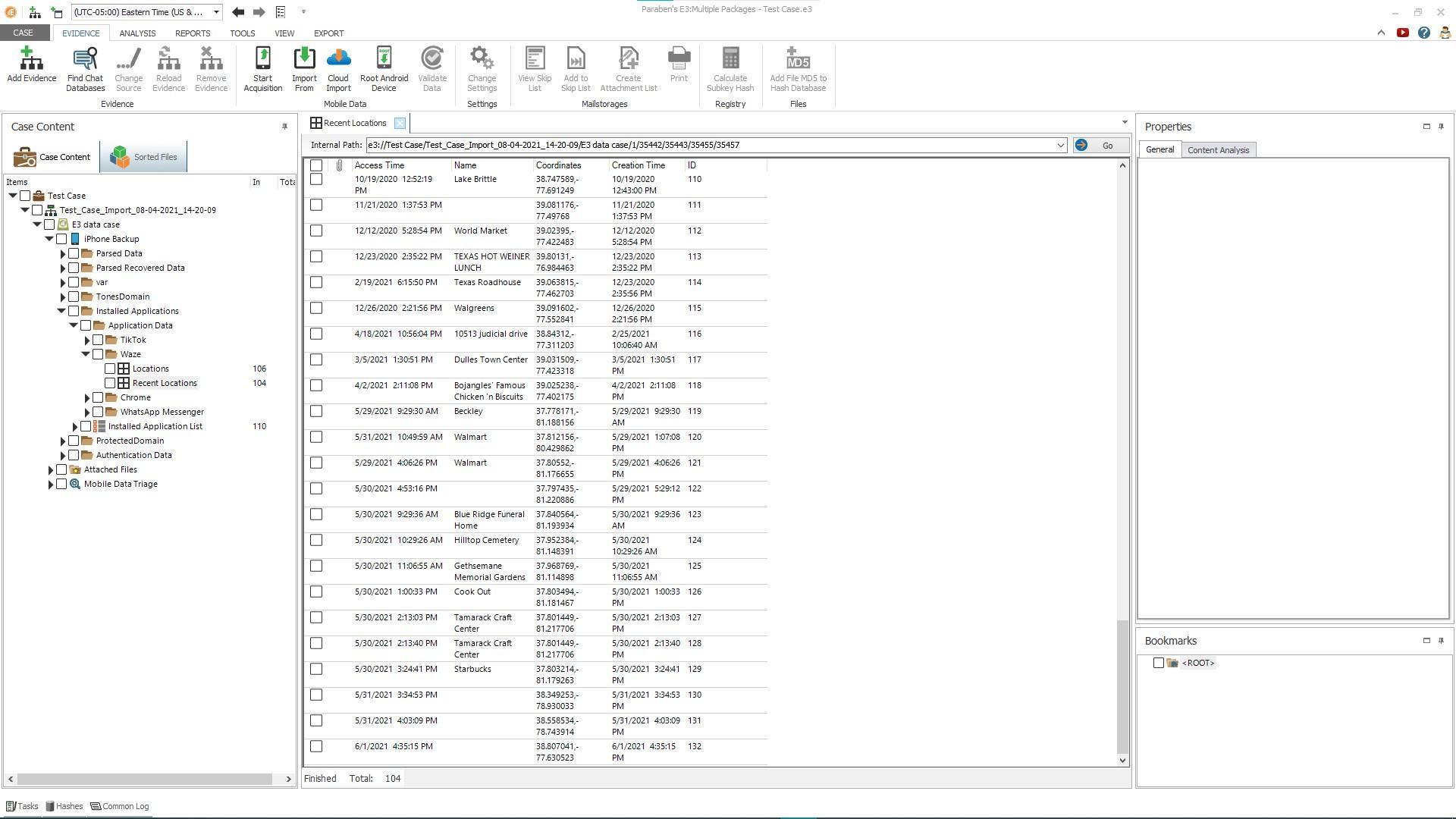
To make the discovery of this data easy the E3 Platform provides this information in the parsed Apps area as well as in the Mobile Data Triage. Many times, where a suspect is at the time of a potential incident can be critical in an investigation and still somewhat difficult to prove. Working with data from Apps like Waze make this process just a little bit easier.


Forensic-Impact Articles

Why Digital Evidence Needs a Behavioral Read, Not Just a Technical One
Guest Blogger: Kevin Schell No matter what your line of work, you’ve sat across from someone and thought you could read them, something in their eyes, the way they moved. It’s a gut thing. You can’t say whether it’s right, and when researchers have tested it, as in...

Blockchain Forensics Is Only the Beginning
Bridging On-Chain Analysis, OSINT, and Digital Evidence Guest Blogger: Matthew Stern Cryptocurrency investigations are often described as the virtual equivalent of “following the money.” Public blockchains such as Bitcoin and Ethereum give investigators an unusual...

Building an Autonomous Network Honeypot & Deception Matrix
Guest Blogger: Fuzuyise Khoza 1. INTRODUCTION TO LOCAL NETWORK DECEPTIONTraditional network defense mechanisms operate reactively, relying on alert signatures after a system breach has occurred. In low-resource enterprise infrastructures or high-risk operational...