By Corentin Garin
A new case lands on your desk. A local company is hit by a wave of negative reviews and hostile messages. It supplies components to the energy sector. The obvious read is online harassment, and most investigations would stop there.
Look closer. The accounts were all created the same week. They post during office hours in a time zone thousands of kilometers away. A "local news" site, really a template with a town name on it, amplifies the story, and fifteen near-identical sister sites sit on the same hosting.
That is not a troll. Harassment is personal; this is structured. You may be looking at a foreign influence operation.
What FIMI actually means
FIMI stands for Foreign Information Manipulation and Interference, the term the EU uses for coordinated, intentional manipulation of the information space by state or non-state actors and their proxies. The target is not a person or a company as such, but the values, procedures and political processes of a society.
One idea matters more than any definition: FIMI is judged on behavior, not on whether the content is true. A perfectly accurate post can be part of an operation if it is pushed by fake accounts in a coordinated way. A malware analyst classifies a file by what it does, not by what it claims to be.
If you know MITRE ATT&CK, you already have the mental model. DISARM is the open framework that does for influence operations what ATT&CK does for intrusions: a shared catalog of tactics and techniques, so analysts describe the same behavior in the same words.
Where your evidence meets the influence operation: hack-and-leak
Sometimes the intrusion and the influence operation are the same operation. In a hack-and-leak, one team gets in, and the operation decides what gets published, when, and through whom.
The 2017 French presidential campaign is the textbook case. Roughly 20,000 emails and documents from Emmanuel Macron's campaign were dumped online two days before the runoff, and the #MacronLeaks hashtag spread within hours, with signs of automated amplification. A 2020 US indictment later tied the phishing behind the breach to GRU officers, and in 2025 France publicly tied the GRU to an attempt to destabilize that election.
If you handle a phishing or credential-theft case against a political, media or policy target, your evidence may be the first half of a story whose second half is playing out on social media. Ask who is publishing the material, and how fast.
Three layers of markers
No single indicator proves an influence operation. What you are looking for is a cluster of weak signals across three independent layers.
1. Accounts (who is speaking?)
- Creation dates bunched into a narrow window, followed by dormancy until the accounts are "activated"
- Templated handles: a name plus a numeric suffix, or sequential usernames
- Reused or stolen profile photos (run a reverse image search), or AI-generated faces
- A posting rhythm that does not match the claimed location: office hours in another time zone, no pause on local holidays
2. Network (how they move together?)
- Identical or near-identical text posted by many accounts within seconds
- Tight loops of replies and reshares among the same small group of accounts
- Content that follows the same route every time, such as a Telegram channel, then social media, then a "news" site
3. Infrastructure (what sits underneath?)
- Domains registered in batches, with the same registrar and hosting
- Shared analytics or advertising IDs across supposedly unrelated sites
- The same site template, page structure and boilerplate text, with only the town or brand name swapped
This layer is where your skills matter most. You already pivot on infrastructure for a living. Applied to a news site instead of a command-and-control server, the same habits work.
Two cautions. First, "coordinated" does not mean "foreign": fandoms, activist groups and PR agencies also coordinate. Second, you are characterizing behavior and networks, not unmasking the people behind them.
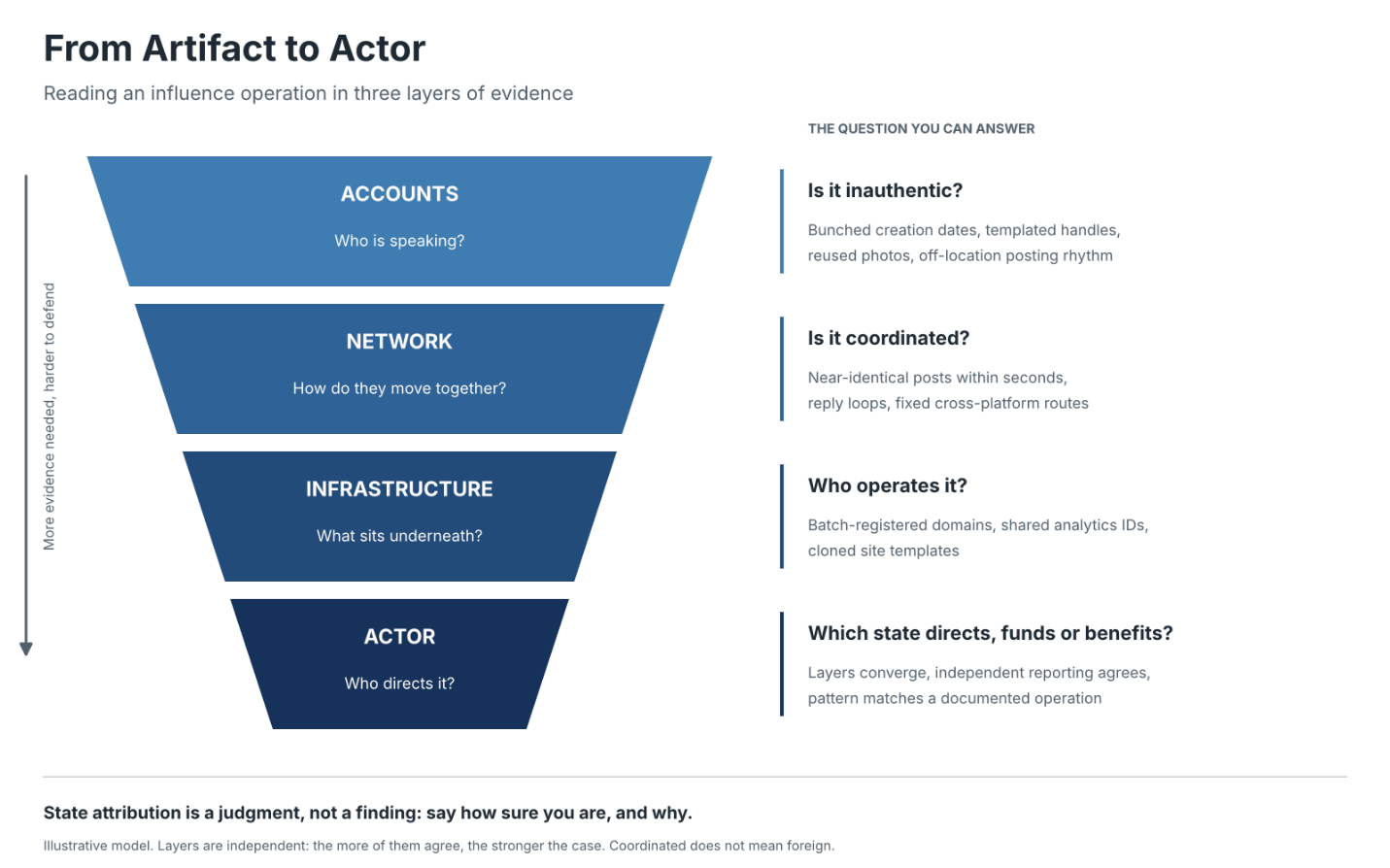
Figure 1. From artifact to actor: the three layers of evidence and the question each one lets you answer. State attribution sits at the end, and it is a judgment, not a finding.
Attribution: where most analyses go wrong
Two questions get mixed up constantly. Who operates this infrastructure? is technical attribution. Which state directs, funds or benefits from it? is strategic attribution. You can be fairly sure of the first and still have little on the second. Report them separately, each with its own confidence level.
Borrow two tools from intelligence analysis. The Admiralty Code rates the reliability of the source and the credibility of the information separately. Analysis of Competing Hypotheses (ACH) makes you test every explanation (state operation, PR firm, activist network, plain trolling) against the evidence, and keep the one with the fewest contradictions, not the one with the most supporting detail.
Public cases show what this looks like in practice:
- Doppelgänger: EU DisinfoLab documented the cloned media sites in 2022 and pointed to Russia-based operators. Meta, then France's VIGINUM in 2023, tied the campaign to named Russian companies.
- Portal Kombat: VIGINUM tied a network of at least 193 sites to a Crimea-based web company, with technical overlaps with a network the US assesses as GRU-administered.
- Spamouflage: Graphika's China-linked assessment rests on years of tracking one network's behavior.
- MacronLeaks: France's cyber agency first judged the attack too generic to attribute; France's public attribution to the GRU came eight years later.
Attribution is a judgment, not a finding. Say how sure you are, and why.
A three-question checklist
When a case feels like more than it looks, ask three questions in order:
- Is it coordinated? Do accounts, posts or domains move together in ways ordinary users would not?
- Is it inauthentic? Are the identities, the audience and the sources what they claim to be?
- Is there a foreign interest? Who benefits, and does the pattern match a documented operation?
You can stop at any step. A coordinated, inauthentic campaign with no visible state link is still worth reporting.
Two rules keep the work defensible. Preserve first: influence networks delete accounts and pages quickly, so capture early, timestamp and hash what you collect, and log the chain of custody, exactly as you would with any other evidence. And never attribute beyond what the evidence supports. "Consistent with" is a perfectly good answer.
To go further, start with the DISARM framework and the public reports from VIGINUM and the EEAS.
Sources
- US Department of Justice, "Six Russian GRU Officers Charged in Connection with Worldwide Deployment of Destructive Malware and Other Disruptive Actions in Cyberspace" (19 October 2020): https://www.justice.gov/archives/opa/pr/six-russian-gru-officers-charged-connection-worldwide-deployment-destructive-malware-and
- French Ministry for Europe and Foreign Affairs, attribution of cyberattacks against France to the Russian military intelligence service, APT28 (29 April 2025): https://www.diplomatie.gouv.fr/en/presse-et-ressources/decouvrir-et-informer/actualites/russie-attribution-de-cyberattaques-contre-la-france-au-service-de-renseignement-militaire-russe
- EU DisinfoLab, "Doppelgänger" (September 2022): https://www.disinfo.eu/doppelganger-operation/
- VIGINUM, "RRN: A complex and persistent information manipulation campaign" (June-July 2023): https://www.sgdsn.gouv.fr/files/files/Publications/20230719_NP_VIGINUM_RAPPORT-CAMPAGNE-RRN_EN.pdf
- VIGINUM, "Portal Kombat" (February 2024): https://www.sgdsn.gouv.fr/files/files/20240212_NP_SGDSN_VIGINUM_PORTAL-KOMBAT-NETWORK_ENG_VF.pdf
- Graphika, "Spamouflage" (September 2019): https://www.graphika.com/reports/spamouflage
- EEAS, Information Integrity and Countering FIMI: https://www.eeas.europa.eu/eeas/information-integrity-and-countering-foreign-information-manipulation-interference-fimi_en
- DISARM Foundation: https://www.disarm.foundation