

Guest Blogger: Anas Zahid
Fileless malware has become one of the most challenging threats facing modern defenders. Unlike traditional malware, fileless attacks often operate entirely within memory, leveraging trusted operating system components such as PowerShell, Windows Management Instrumentation (WMI), and other legitimate binaries to execute malicious actions while leaving little or no evidence on disk.
For incident responders, this shift fundamentally changes the investigation process. Traditional forensic workflows frequently rely on disk artifacts, executable files, registry modifications, and persistent malware samples. Fileless threats deliberately minimize these artifacts, forcing investigators to rely on volatile evidence that exists only while the system remains operational.
This article presents a practical investigation workflow designed to address this challenge through volatile memory forensics. Using a controlled malware-analysis environment and a collection of open-source DFIR tools, the project demonstrates how investigators can acquire, analyze, correlate, and report memory-based evidence that would otherwise be lost.
The Investigation Challenge
Fileless malware is designed to exploit a fundamental weakness in many forensic investigations: the assumption that evidence will persist on disk.
Modern attackers increasingly abuse legitimate system tools, inject code into trusted processes, and execute payloads directly within memory. As a result, traditional forensic approaches may recover only partial evidence of an attack.
Investigators face several challenges:
- Evidence disappears after reboot.
- Malicious payloads may never exist as standalone files.
- Process injection obscures attribution.
- Traditional antivirus solutions may not generate useful artifacts.
- Disk imaging alone cannot fully reconstruct runtime behavior.
These challenges make memory acquisition and analysis a critical capability for modern DFIR teams.
Building the Investigation Workflow
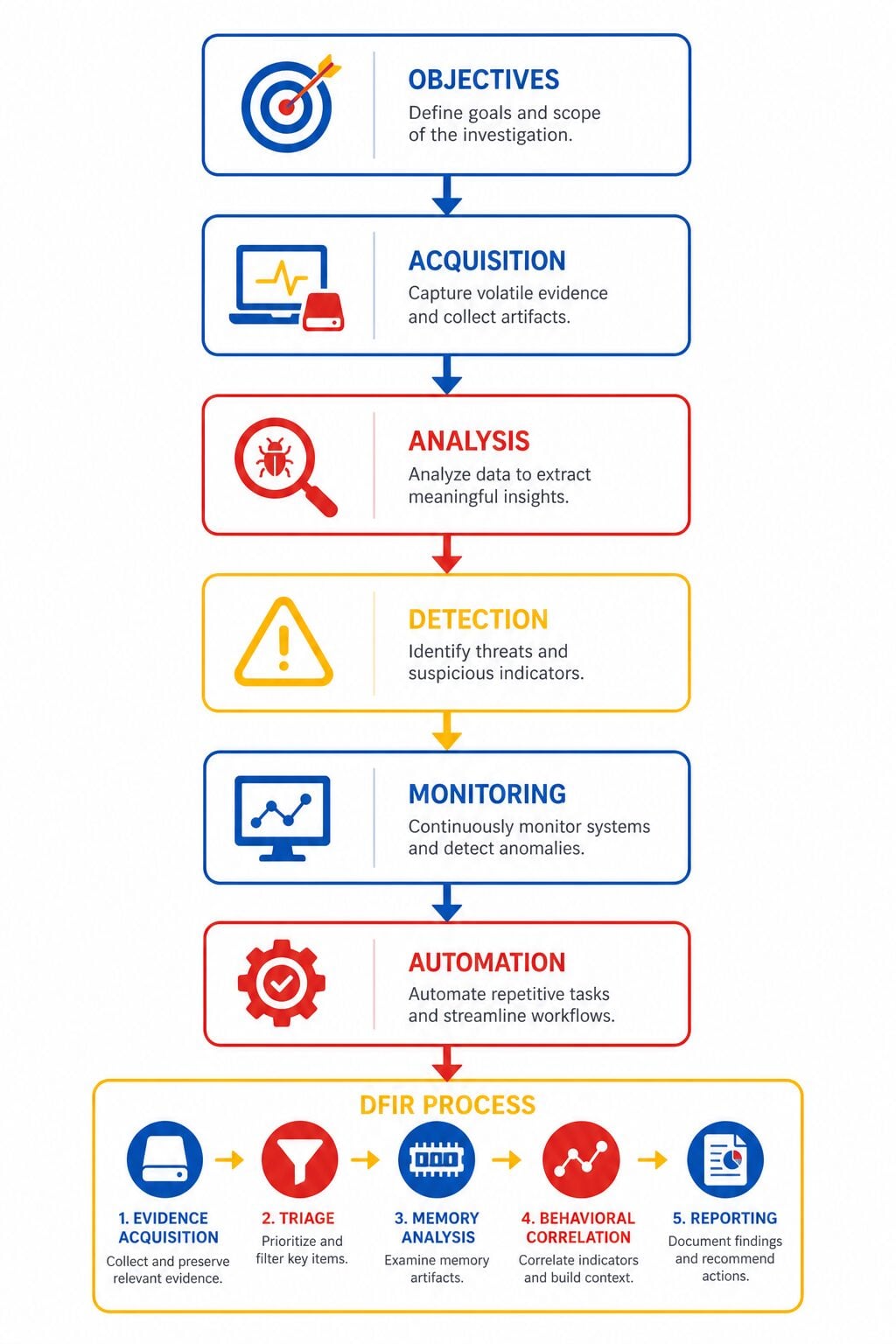
To address these challenges, a structured investigation workflow was developed around four major objectives:
- Capture volatile evidence.
- Analyze memory artifacts.
- Correlate behavioral indicators.
- Automate repetitive investigative tasks.
The workflow combines multiple open-source tools into a repeatable investigation process.
Acquisition Layer
Memory acquisition was performed using:
- Magnet RAM Capture
- WinPmem
- FTK Imager
- Redline
Each tool was evaluated for acquisition speed, ease of use, output compatibility, and suitability for incident response scenarios.
Analysis Layer
Memory analysis focused on:
- Process enumeration
- Process hierarchy reconstruction
- Network artifact recovery
- Command-line extraction
- Registry analysis
- Detection of suspicious memory regions
Volatility 3 served as the primary analysis framework.
Detection Layer
YARA rules were used to identify:
- PowerShell abuse
- Suspicious scripts
- Memory-resident malware indicators
- Known malware signatures
Monitoring Layer
Additional telemetry was collected through:
- Sysmon
- Wireshark
- TCPView
- Process Monitor
- Autoruns
- Regshot
This telemetry enabled behavioral correlation between memory artifacts and system activity.
Automation Layer
A custom Python-based automation framework was developed to:
- Process memory images
- Execute Volatility plugins
- Perform YARA scanning
- Consolidate findings
- Generate structured reports
Automation reduced repetitive analyst tasks and improved consistency across investigations.
Analysis Process
The investigation followed a standard DFIR lifecycle.
Evidence Acquisition
Malware samples were executed within a controlled virtualized environment. Memory acquisition occurred immediately after execution to preserve volatile artifacts before evidence degradation.
Preservation
Collected evidence was preserved using forensic acquisition tools and documented to maintain integrity throughout analysis.
Triage
Initial triage focused on identifying suspicious memory activity, malicious execution chains, and behavioral anomalies.
YARA-assisted scanning accelerated identification of potentially malicious artifacts and helped prioritize analysis efforts.
Memory Analysis
Volatility 3 was used to examine memory structures and identify:
- Active processes
- Hidden processes
- Suspicious memory allocations
- Network connections
- Command execution artifacts
- Registry-related indicators
Special attention was given to executable memory regions and indicators of process injection.
Behavioral Correlation
Memory findings were correlated with:
- Sysmon telemetry
- Network traffic
- Registry changes
- Process execution history
This correlation improved investigative confidence and reduced reliance on any single evidence source.
Reporting
Automated reporting consolidated findings into structured outputs suitable for DFIR documentation and incident response workflows.
Key Findings
Several significant findings emerged during the investigation.
Memory Artifacts Provided Superior Visibility
The investigation consistently demonstrated that memory analysis revealed artifacts unavailable through traditional disk-based examination.
Critical evidence existed only within volatile memory and would have been lost after system shutdown.
Process Injection Indicators Were Observable
Analysis identified evidence consistent with malicious code operating inside trusted processes.
Rather than relying on standalone executables, malware activity appeared within legitimate system processes, making traditional detection methods less effective.
Suspicious Executable Memory Regions Were Detected
Multiple executable memory regions displayed characteristics commonly associated with memory-resident malware.
These findings reinforced the importance of memory analysis when investigating modern threats.
Network Activity Was Recoverable
Memory analysis successfully recovered network-related artifacts and active communication indicators.
This visibility improved understanding of malware behavior and external communications.
Behavioral Monitoring Strengthened Attribution
While attribution remained outside the primary scope of the project, combining Sysmon telemetry, network observations, and memory artifacts improved understanding of attacker activity.
Automation Improved Investigation Efficiency
Automated execution of Volatility plugins and reporting significantly reduced analyst workload while maintaining investigative consistency.
The workflow demonstrated that even resource-constrained organizations can benefit from automation without requiring expensive commercial solutions.
Lessons Learned
Several practical lessons emerged from the project.
Acquire Memory Early
Volatile evidence is time-sensitive. Delays in acquisition increase the risk of losing critical forensic artifacts.
Disk Evidence Alone Is Insufficient
Modern fileless malware frequently avoids creating meaningful disk artifacts. Memory analysis must become a standard component of incident response.
Correlation Is Essential
No single artifact provides a complete picture. Effective investigations require correlation across memory, network, registry, and behavioral data sources.
Open-Source Tooling Is Highly Capable
The project demonstrated that mature DFIR investigations can be conducted using freely available tools when combined within a structured workflow.
Automation Improves Consistency
Analysts often perform repetitive tasks during investigations. Automating these activities improves efficiency while reducing human error.
Forensic Readiness Matters
Organizations should prepare acquisition procedures, tooling, and workflows before incidents occur. Readiness significantly improves investigation effectiveness during real-world events.
Conclusion
The continued growth of fileless malware has exposed the limitations of traditional disk-centric forensic investigations. Memory-resident threats exploit trusted system components, evade conventional detection mechanisms, and frequently leave little evidence on permanent storage.
This project demonstrated how volatile memory forensics can provide critical visibility into these attacks through structured acquisition, analysis, behavioral correlation, and automated reporting. By combining memory acquisition tools, Volatility 3, YARA-assisted triage, behavioral monitoring, and automation, investigators were able to identify malicious activity that would otherwise remain hidden.
For DFIR practitioners, the findings reinforce a simple reality: effective investigation of modern threats increasingly depends on the ability to acquire and analyze memory. As attackers continue to adopt fileless techniques, memory forensics will remain one of the most valuable capabilities available to incident responders.







Forensic-Impact Articles

How Government Buyers Can Verify Digital Forensics Vendor Provenance: A Practical Guide
When government agencies buy digital forensics tools, they aren't just buying software. They're investing in the integrity of evidence that can affect people's liberty, national security and public trust. Recent federal attention to supply chain and foreign-adversary...

The Four Foundation Questions of Digital Forensics
In digital forensics, technology moves at lightning speed and lately at GPU speed as well. Apps, encrypted mobile operating systems, cloud artifacts, and complex IoT devices change almost daily. Yet, despite this constant evolution, the core foundation of legally...

Before Direct NAND Acquisition: Diagnosing an Undetectable Monolithic SD Card
Guest Blogger: Yevgeniy Kapishon | Aesonlabs Data Recovery Undetectable Is a Symptom, Not a Diagnosis When an SD card is not detected by a computer, reader or recovery system, the failure is often attributed immediately to the controller or NAND flash memory. With...