

According to Wikipedia Waze is:
Waze is a GPS navigation software app and a subsidiary of Google. It works on smartphones and tablet computers that have GPS support. It provides turn-by-turn navigation information and user-submitted travel times and route details while downloading location-dependent information over a mobile telephone network.
So, like many people you have probably used Waze at one point or another thinking, it will get us to our destination faster or be less annoying than another mapping app. What you might not know about this helpful app for directions is the amount of data it retains that can be used for forensic evidence.

There are two main areas we look at when taking apart the Waze App for evidence. It comes down to location, location, location.
Location Data
In this part of the App you can receive the following data
Name
Street
House
City
State
Country
Coordinates (Latitude and Longitude)
ID
When you parse this data not all of it will be full and available, but as you can see a good percentage does bring about some good evidence.

Recent Data
This area can yield similar results with the following data available.
Access Time
Name
Coordinate (Latitude and Longitude)
Creation Time
ID
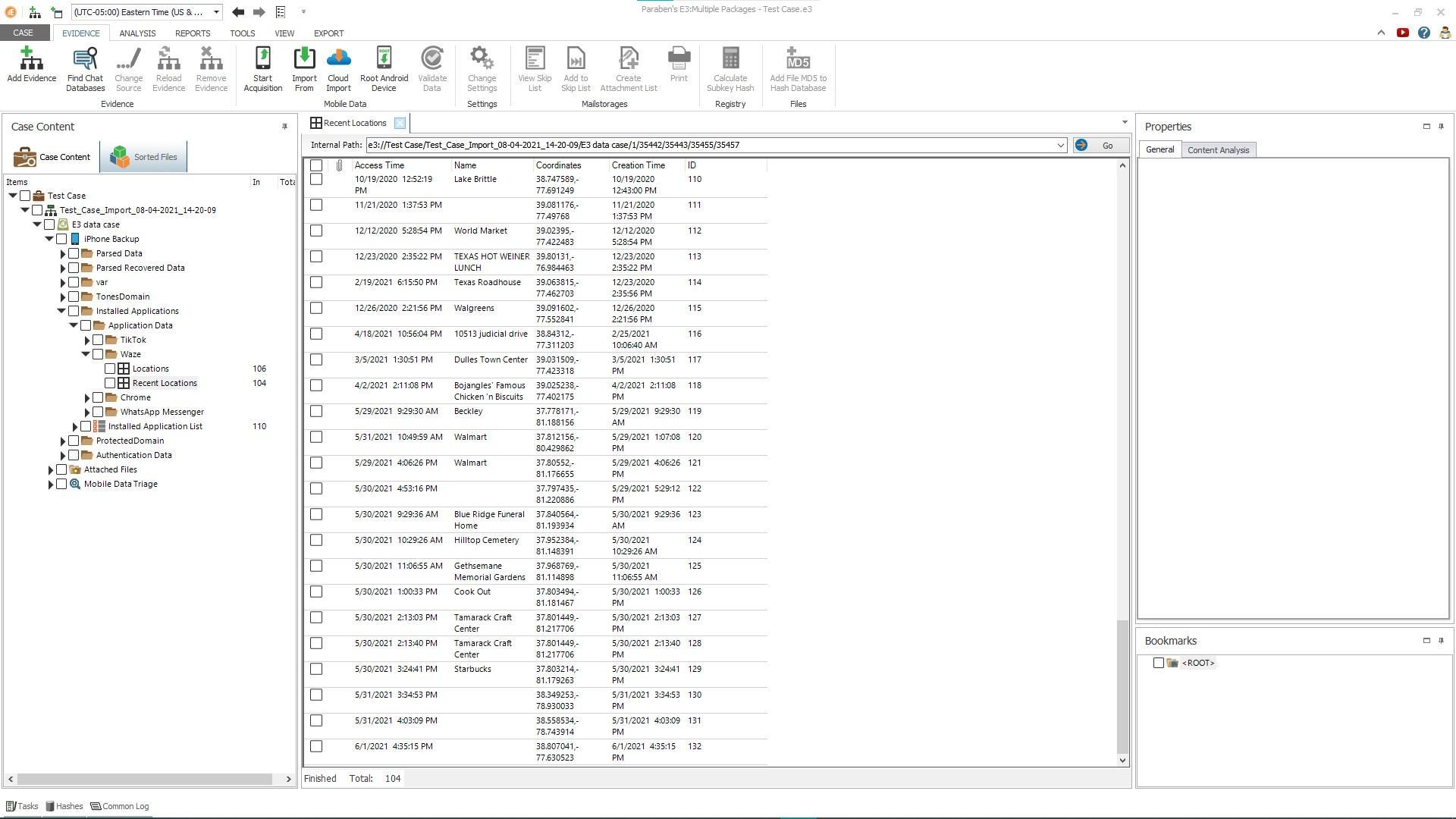
To make the discovery of this data easy the E3 Platform provides this information in the parsed Apps area as well as in the Mobile Data Triage. Many times, where a suspect is at the time of a potential incident can be critical in an investigation and still somewhat difficult to prove. Working with data from Apps like Waze make this process just a little bit easier.


Forensic-Impact Articles

Before Direct NAND Acquisition: Diagnosing an Undetectable Monolithic SD Card
Guest Blogger: Yevgeniy Kapishon | Aesonlabs Data Recovery Undetectable Is a Symptom, Not a Diagnosis When an SD card is not detected by a computer, reader or recovery system, the failure is often attributed immediately to the controller or NAND flash memory. With...
How OSINT Supports Compliance and Due Diligence
Guest Blogger: Issam Hanbali Open-source intelligence, commonly known as OSINT, is often associated with cybersecurity investigations, digital forensics, threat actor research, and online reconnaissance. However, OSINT also plays an increasingly important role in...
No Photons, No Alibi
A Conservation-of-Trace Framework for Authenticating Imagery in the Age of Generative AIGuest Blogger: Khaled S. Al Sannat Generative models have dissolved the oldest working assumption of visual evidence: that a photograph is, by default, a witness. The reflex of the...